
How To Ask for Support from Senior Leaders
How to take advantage when your leader says "let me know how I can help." Use it to accelerate your projects and your career while increasing perception of competence and skill.

Client: I’m starting to build a good rapport with my skip level and another VP in the organization. They seem invested in my growth. They often tell me to “reach out if I can help with anything,” or “let me know how I can help.” I don’t really know what to ask of them. How can I best use their support?
When I started working at Instagram, I made it a point to meet senior leaders across different functions and teams. I wanted to build my relationships and visibility from the start. Frequently, the leader would invite me to “reach out for help.” For years, I did not take advantage of these offers. I didn’t really know how. I chalked it up to one of those nice gestures that one offered but did not expect to be taken up.
It turns out that senior leaders do truly want to help. One VP asked me during a subsequent one-on-one a few months later why I hadn’t reached out with any asks. It took my managers at Meta working with me for weeks on why I wasn’t explicitly asking for help for me to finally learn to take advantage of these offers. And when I became a Chief Product Officer, I finally realized how much I had made it harder for myself along the way.
First, The Mindset Shift
The first thing I had to unlearn was the idea that I needed to get everything done myself. That asking for help was a sign of failure. And that asking for help from a senior leader was the same as walking myself out of the company.
I feared others knowing I was struggling with a project. I feared being taken advantage of or being perceived as lacking capability. As a result, I worked long hours trying to figure it out myself. Progress was often glacially slow, and conversations seemed to go in circles. I grew increasingly frustrated at myself, and it showed up in being short-tempered, impatient, or unnecessarily pessimistic.
It turns out that knowing when, who, and how to ask for help is an essential leadership skill. Without it, projects and decisions drag on unnecessarily or balloon into bigger problems that are harder to address. Instead of trying to solve everything myself, I needed to figure out how to bring visibility to my challenges and effectively bring others in to help with a resolution. It was not a judgment on my lack of ability. The challenges I needed to ask for help on were decisions and situations outside my ability to control or influence.
When To Ask For Help
While it’s important to ask for help, knowing when to ask for help is a judgment call. If the challenge is too simple, you risk others (or your inner critic) questioning your capabilities. If you wait too long, you let a problem grow disproportionate and harder to resolve, even for the leaders. Here’s how to think about this balance:
Is the challenge in an area where you are the expert? The more the challenge is outside your area of expertise, the earlier the ask should be made.
Does the challenge require coordination across multiple teams outside your span of control? The more cross-functional or cross-team the challenge, the better it is to ask for help early. Don’t try to wrangle all the cats yourself.
Does it require an exception from a leader outside your line of command? If you’re trying to accomplish something that goes outside business as usual, ask for support early.
When in doubt, err on the side of asking for help earlier. Quite frequently, your ego and fears prevent you from reaching out. When you do reach out, take the time to strategize on the type of help you need.
Types of Asks For Help
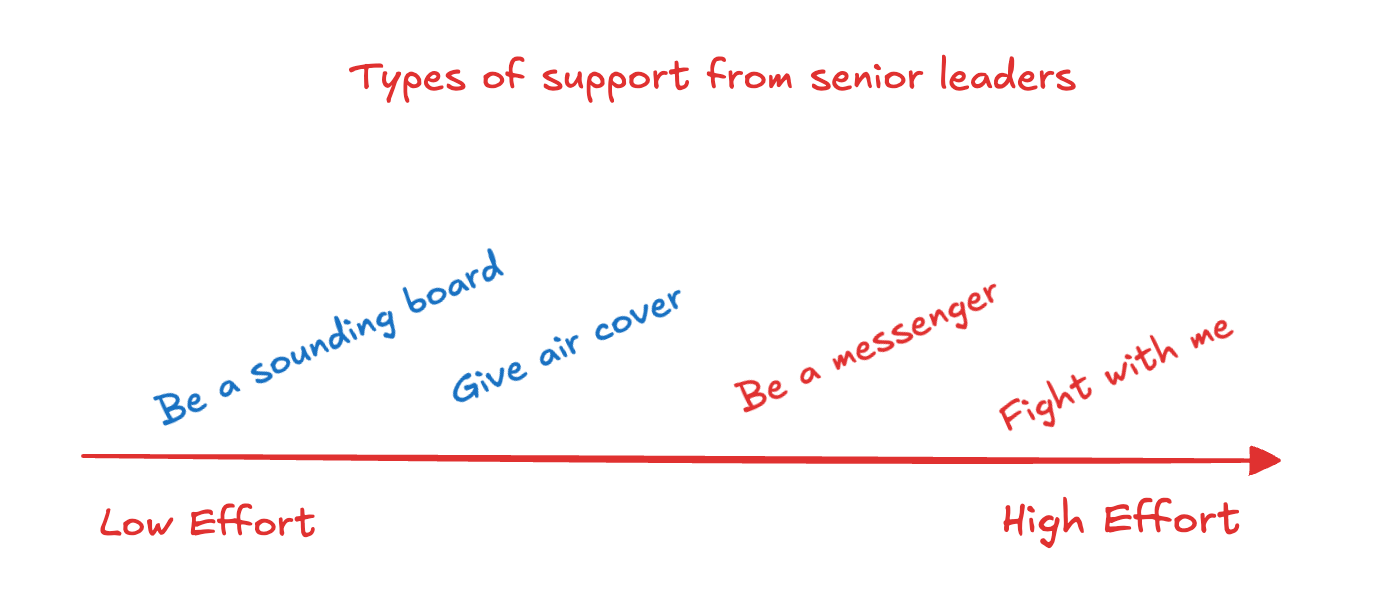
In the beginning, I thought that when I asked for help, it meant that the other person had to do the work for me, which I often did not want. It turns out that there are many types of help a leader can provide, some of which play really well to their position and strengths.
The way to think of the type of ask is how involved the other person needs to be:
Be A Sounding Board: This is the lightest touch for the leader. You are asking them to simply listen and give you guidance from their perspective.
Give Air Cover: You are asking that they back up what you’re saying in a group setting or support you when others raise concerns about your actions. The leader is agreeing with you publicly, and as a result, sharing their power and influence with you.
Be A Messenger: In this scenario, the leader helps you deliver an uncontroversial message to others. This ask is made when they have access to people and conversations that you do not have, or when you need help getting many people to align in a short amount of time.
Fight With Me: This is the most involved scenario where the leader needs to go and convince others with you. They are actively creating new arguments and taking on a part of the work. This requires much more work from them and for them to actively put their credibility on the line.
I believe that one of the best default asks for leaders is to give you air cover. It is low effort and reactive. It is a type of help that you can ask for in advance of knowing exactly when it’ll be needed. “I’m going to go do X. Can you support with air cover if needed?” It also allows you to maintain the initiative and control while the leader plays a supporting role. This makes it easier to make the ask as well.
That’s all folks! See you next week at 3:14 pm.
Yue
Yue’s Coaching Corner

1 spot left (!) for the Jan cohort of The Uncommon Executive Leadership Accelerator. Join 4 other leaders in mastering critical soft skills in leadership. Rated 5/5 by past students. Apply here!
If I need a leadership to put a mandate for other leaders to follow, is that getting Air Cover or something more?
e.g. I convince a Engineering leader to put out a mandate that all orgs must push their data into the data-warehouse with their meta data so that the newly built metric system from the Data org can provide insights upstream.